Why communication changes after stroke (and what you can do)

Communication after a stroke can feel unpredictable. Here’s what’s going on in your brain, why it varies day to day, and simple strategies that make conversations easier.
What happens to communication after a stroke
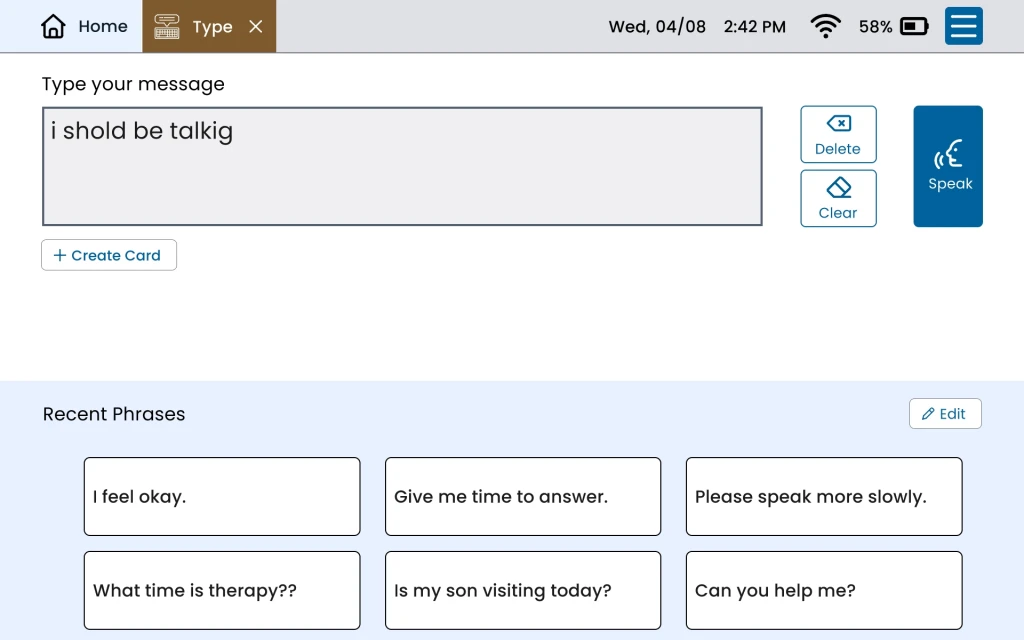
“I shold be talkig.”
☝️That’s the exact message a person with communication challenges typed out to me on her communication board after she survived a second stroke.
She knew exactly what she wanted to say, she just couldn’t get it out.
If you’ve had a stroke, you might notice that communication feels different now.
Maybe some days words come easily, but other days they just won’t come out. Or you understand everything perfectly in the morning, but by afternoon, conversations feel harder to follow.
Your brain hasn’t given up on you. It’s working hard to heal and find new ways to help you communicate. Some days will be easier than others, and that’s okay.
Let’s talk about why communication changes after a stroke and what you can do to make communication a little easier.
What’s happening in your brain after stroke
When you have a stroke, it can affect the parts of your brain that control communication, depending on where the stroke happened in your brain.
Think of your brain like a busy office building where different departments handle different jobs. Some areas help you find words, others help you understand what people are saying, and others coordinate the movements needed for clear speech.
After a stroke, some of these “departments” might need time to heal or find new ways to do their jobs. This can cause:
- Trouble finding the right words – You know what you want to say, but the word just won’t come.
- “Understanding” challenges – Following conversations, especially in noisy places, feels harder to understand.
- Speech clarity issues – Your mouth doesn’t always cooperate with what your brain wants to say.
- Processing changes – It takes more time and energy to think through what you want to communicate.
Many people develop something called aphasia after a stroke, which affects how you use and understand language.
These communication problems after a stroke are common and often change depending on energy, stress, and environment.
The important thing to remember is that your intelligence hasn’t changed. Your brain is just finding new pathways to help you communicate.
Why communication feels different from day to day
Ever notice how some mornings you feel sharp and ready to chat, but by evening, even simple conversations feel exhausting? There’s a good reason for this.
After a stroke, your brain has to work much harder to do things that used to be automatic – like finding words or following a conversation. It’s like your brain is taking the long way around to get to the same destination.
Here are signs that your brain might be getting tired:
- Words get harder to find as the day goes on
- You feel more confused in noisy or busy places
- You need more time to understand what people are saying
- Simple conversations start feeling overwhelming
This isn’t your fault, and it doesn’t mean you’re not getting better. It just means your brain needs breaks, just like your body does after physical exercise.
Why communication changes from day to day:
- Brain fatigue – Your brain uses more energy now for communication tasks
- Stress – Feeling anxious or rushed makes everything harder
- Environment – Noisy places or distractions affect your focus
- Recovery isn’t linear – Healing happens in waves, not straight lines
Simple communication tips for hard moments
When communication feels hard, you have options – you don’t have to struggle through or give up.
Here are some things that can help right away:
Take your time. There’s no rush. Good communication is worth waiting for, and most people are happy to be patient.
Use your whole toolkit. Communication isn’t just words. Try:
- Gesturing or pointing
- Writing or drawing
- Using your phone to type or show pictures
- Nodding, shaking your head, or using facial expressions
Ask for what you need:
- “Can you slow down?”
- “Can you repeat that?”
- “Let me write this down.”
- “Can we move somewhere quieter?”
Choose your battles. Save your energy for conversations that matter most. It’s okay to keep some interactions short and simple.
Rest when you need to. If you’re feeling tired, take a break. Your communication will be better when you’re rested.
Small things that make a big difference
You don’t need to overhaul your entire life to improve communication. Small, daily habits can make a real difference:
Get enough sleep. Your brain heals and recharges while you sleep. Most people need 7-9 hours, but you might need more as you recover.
Practice in low-pressure situations. Chat with family members who understand your challenges. Read out loud to yourself. Practice ordering coffee when you’re not in a hurry.
Stay connected. Don’t isolate yourself because communication is harder. The people who care about you want to hear from you, even if it takes longer than before.
Be patient with yourself. Recovery takes time. Celebrate small wins – like remembering a word that was stuck yesterday, or having a good conversation with a friend.
When you need extra support
Sometimes, even with all these strategies, you might need extra help communicating. That’s where tools like AAC devices can make a difference.
AAC stands for Augmentative and Alternative Communication. These are tools – from simple communication boards to high-tech devices – that can help you express yourself when words are hard to find.
Think of AAC like reading glasses. It doesn’t replace your vision – it just helps you see more clearly. AAC doesn’t replace your speech – it gives you another way to communicate when you need it.
Some people use AAC devices temporarily while their speech improves. Others use them long-term as a reliable backup. Both approaches are perfectly fine. The goal is communication that works for you.
How care partners can help
If you’re a caregiver reading this, here’s how you can support communication without adding pressure:
Give extra time. Don’t rush conversations or finish sentences unless you’re asked to help.
Stay patient and encouraging. Your loved one is working hard, even when it doesn’t look like it.
Learn together. The more you understand about stroke and communication changes, the better you can support recovery.
Take care of yourself too. Supporting someone with communication challenges can be emotionally demanding. You need breaks and support as well.
For both stroke survivors and care partners, this comprehensive webinar about stroke and the brain offers deeper insights into what to expect during recovery.
You’re not alone in this
Communication changes after stroke are real, challenging, and completely normal. Some days will be harder than others, and that’s part of the recovery process.
But the good news is you can improve.
Your brain is remarkably good at finding new ways to help you communicate. With time, patience, and the right strategies, many people find that communication becomes easier.
While it’s tempting to think that recovery means getting back to exactly where you were before, the reality is that recovery is all about finding new ways to connect, express yourself, and participate in the conversations that matter to you.
Remember the patient I mentioned at the beginning, who typed out that she “should be talking”?
She wound up using an AAC device as her daily support system – and she was heard loud and clear by anyone in her path. She was talking again – it just looked a little different!
So remember, take it one day at a time. Be patient with yourself.
Every small step forward is progress worth celebrating.