AAC Devices for Adults With Aphasia
Chances are, you didn’t wake up planning to research AAC today. Something happened, or someone you care about is having a harder time being understood than they used to because of aphasia.
Maybe pointing at words and objects has become the go-to communication method, although it’s not always successful.
Moments like these are usually what lead a family to a term they haven’t encountered before: AAC.
If you’re just now hearing or researching it for the first time, we’re glad you’ve found us. Most care partners are introduced to AAC in the middle of an already overwhelming week, often in a single sentence from a doctor or speech-language pathologist (SLP) who has said it a thousand times before.
This article slows that moment down.
Keep reading to learn what AAC devices for aphasia actually do, how they help someone communicate, and what to think about as you consider next steps.
What is AAC, exactly?
AAC stands for “augmentative and alternative communication.” It’s a broad category that includes any tool or strategy that supports communication beyond speaking alone.
AAC for aphasia can look like a lot of things:
- Gestures and facial expressions
- Paper communication boards with pictures or letters
- Notebooks
- Apps or dedicated devices that speak words aloud
Some strategies use no technology at all, while others rely on speech-generating software.
For adults with aphasia, AAC is a system of supports rather than a single gadget. A person might use several AAC strategies together, such as pointing to a printed board during a doctor’s visit and switching to a tablet app at home.
AAC works alongside speech — whether they’re able to speak lots of words, just a few, or none. It gives the person with aphasia more ways to get their message across.
How an AAC device helps someone with aphasia
Aphasia affects language, not intelligence — and that’s an important distinction! Someone with aphasia often knows what they want to say. The words simply don’t come out the way they intend: whether they’re mixed up, incomplete, or missing altogether.
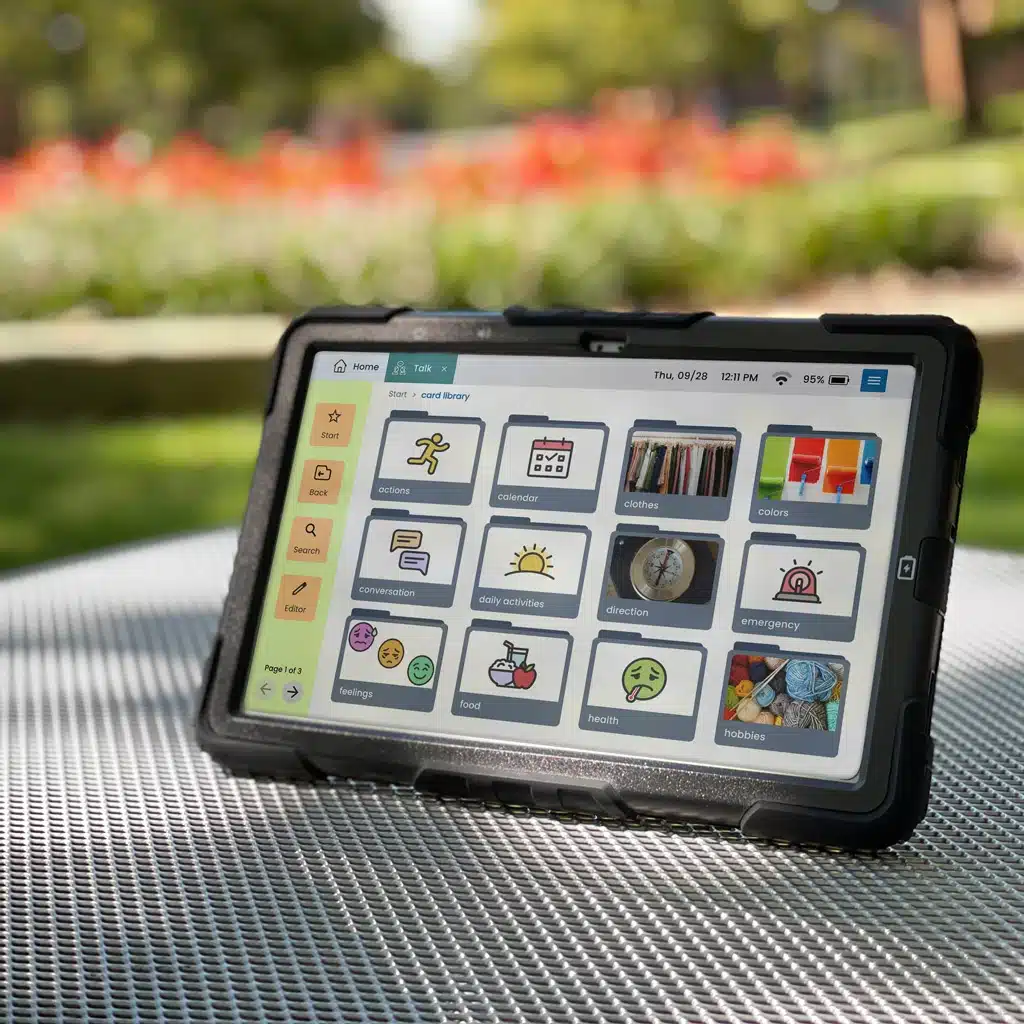
An AAC device offers another path to that same message. Many devices combine pictures, written words, and recorded or computer-generated speech, so a person can select an icon or phrase and hear it spoken aloud.
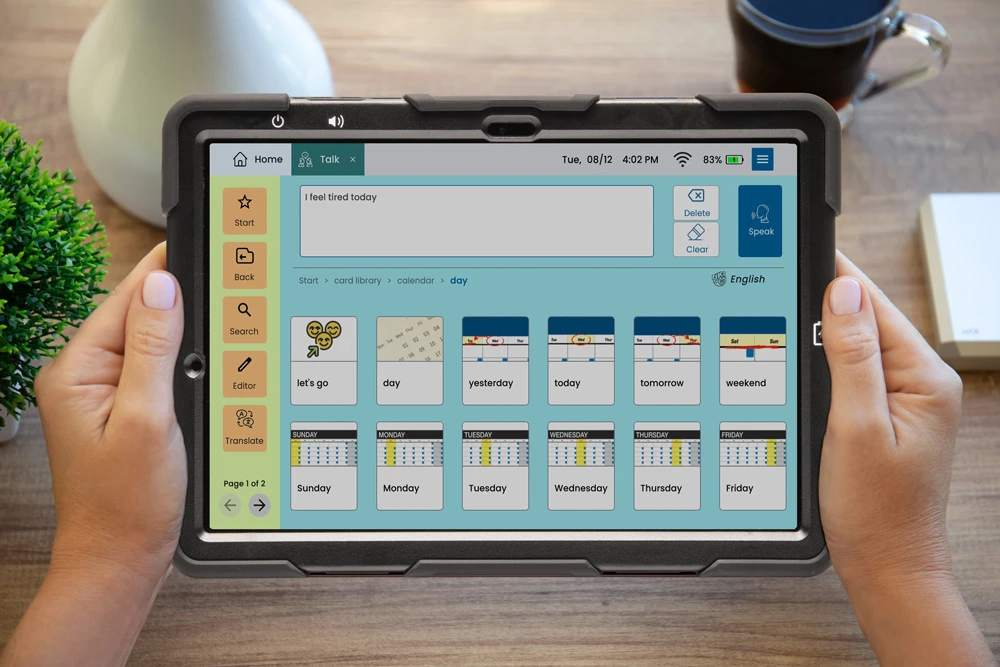
Seeing a related picture, reading, and hearing a word together can also support the brain’s own language recovery. This gives the person with aphasia more ways to practice retrieving and producing words over time.
Essentially, an AAC device can help someone with aphasia:
- Answer questions and make choices independently, from ordering at a restaurant to managing a medical appointment
- Reconnect with hobbies, work, and relationships that require more sustained conversation
- Rely less on a care partner to translate or speak on their behalf
- Practice speech and language skills as part of ongoing rehabilitation and therapy
Low-tech and high-tech AAC options
AAC exists on a spectrum, and there’s no single right starting point. Options generally fall into two categories.
Low-tech AAC includes tools like printed communication boards, picture books, alphabet cards, and simple whiteboards. These require no batteries or software. They’re inexpensive, and they work almost anywhere. They’re especially useful in places where a device isn’t always practical (like a swimming pool or the bathroom) or as a backup when a high-tech device needs to be charged or repaired.

High-tech AAC includes apps on a tablet or phone, along with dedicated speech-generating devices designed specifically for communication. These typically offer much more vocabulary, faster access to full sentences, and personalization — so a person’s AAC device can reflect their own life and voice.
It’s common for people to use both types of AAC. A low-tech board might live in the bathroom or your emergency bag for quick, on-the-go communication. A high-tech device supports richer, longer conversations throughout the day and in therapy. An SLP can help determine which combination fits a person’s needs, goals, and daily life.
What makes an AAC device a good fit for adults with aphasia
Not every AAC tool is designed with aphasia in mind. Fit matters more than having all the newest features. Here are a few things to consider:
Aphasia-specific design: Devices intended for adults with aphasia typically favor recognizable photos and simple layouts over abstract symbols, since many people with aphasia also experience some difficulty with reading and writing.
Room to grow, or simplify: Aphasia can change over time, sometimes improving with therapy, sometimes staying the same. A good device can be adjusted, whether that means adding vocabulary as someone progresses or simplifying the layout or colors based on vision needs.
Support for the whole household: Care partners are often deeply involved in daily communication, so a device that’s easy for the whole family to learn and personalize together tends to get used more consistently. Consider the AAC tool’s long-term tech support options and ensure you’ll still be able to receive help if you have questions in a year or two.
Guidance from an SLP: A speech-language pathologist can assess a person’s specific communication strengths and challenges, recommend an approach to AAC and therapy, and help introduce it gradually. Aphasia therapy often incorporates AAC as one part of a broader plan.
When to start using AAC
One of the most common questions care partners ask is, “When is the right time to introduce AAC?”
The short answer: sooner than you might expect.
Research shows AAC can be introduced early in aphasia recovery, including soon after a stroke, without slowing down natural speech.
Research tells us 3 important things about aphasia recovery and augmentative and alternative communication (AAC):
- Introducing AAC early can improve language recovery for people with aphasia.[1,2] It can be introduced early in aphasia recovery — including soon after a stroke — without slowing down natural speech.
- Using AAC can increase a person with aphasia’s confidence and motivation when communicating because they have a “backup plan” in case they can’t find the words they want to say.[2]
- AAC can improve language function for people with chronic aphasia — even years after a stroke, injury, or illness.[3]
People with primary progressive aphasia, a condition where language abilities decline gradually over time, can also benefit from AAC. Introducing AAC early helps the device user and their caregivers become familiar with AAC before they need to rely on it daily.[4] Learning a new tool is often easier before communication becomes more difficult, so building familiarity early can make AAC more useful later, when it’s needed most.
If you’re unsure whether it’s the right time to try AAC, a conversation with an SLP is a good place to start. They can evaluate your loved one’s current communication and offer guidance based on their specific situation.
How to get an AAC device for aphasia
Getting an AAC device usually starts with an evaluation. A speech-language pathologist assesses a person’s communication needs, tries out different tools, and helps determine which type of device, if any, is the best fit. From there, the process typically includes:
- A trial period with a device, so the person and their family can test the AAC device in real, everyday situations
- Support with funding or insurance coverage, since many AAC devices may be covered depending on a person’s health insurance plan
- Training for the person with aphasia and their care partners
- Ongoing adjustments as needs change over time
If you’re ready to learn more about what this process looks like, Lingraphica walks through AAC devices for adults with aphasia in more detail, including what to expect at each step.
Where to find support along the way
You don’t have to figure this out on your own. A number of free resources exist specifically for care partners and adults navigating aphasia and AAC.
Join In offers free virtual groups where people with aphasia and their care partners can connect with others on similar journeys.
Our webinars cover a range of topics, from communication strategies to building confidence with AAC, and are free to attend.
Free downloads, including communication boards and other printable tools, are available if you want to get started with low-tech AAC right away.
If you’re looking for a fuller picture of what recovery can involve, our guide to rehabilitation and therapy after a stroke is a good next stop.
Learning about AAC and aphasia is a process, and it’s okay to feel overwhelmed and frustrated at times. Whatever stage you’re at, support is available every step of the way.